

Get to know LSA Board Trustee Asad L. Asad!
Institution:
Stanford University
Number of years as LSA member:
10+
Number of LSA Meetings Attended:
10+
LSA Governance Position(s) and Committees:
Board of Trustees, Class of 2026
Other Association Affiliations:
American Sociological Association
Population Association of America
Areas of Research:
Surveillance
International Migration
Immigration Enforcement
Health
Favorite Topics to Teach or Research:
Race and Immigration
Unique Skill or Fact:
I’m an armchair commentator of professional tennis. I may or may not have a social media presence devoted to match analysis and hot takes. The evidence is inconclusive.
Additional Hobbies:
Pets
Reading
Television
Travel
Notable Awards and Grants:
Mirra Komarovsky Book Award, Eastern Sociological Society | 2025
Distinguished Book Award, Pacific Sociological Association | 2025
Best Book in Current Events (Gold Medal), Independent Publishers Book Awards | 2025
Best Publication Award, Mental Health Section, American Sociological Association | 2025
IPUMS Health Surveys Best Published Research Award | 2025
C. Wright Mills Award, Society for the Study of Social Problems | 2024
Distinguished Book Award, Sociology of Law Section, American Sociological Association | 2024
Robert J. Bursik Junior Scholar Award, Communities and Place Division, American Society of Criminology | 2024
Louis Wirth Best Article Award, International Migration Section, American Sociological Association | 2019
Top Books and/or Publications:
Engage and Evade: How Latino Immigrant Families Manage Surveillance in Everyday Life. Princeton, NJ: Princeton University Press.
“Spatial and Temporal Contexts of Formal Social Control and System Involvement: U.S. Latinos under Immigration Policing.” Law & Society Review 59(1): 172-208 (with Livia Baer-Bositis).
“Deportation Threat Predicts Latino U.S. Citizens and Noncitizens’ Psychological Distress, 2011-2018.” Proceedings of the National Academy of Sciences 121(9): e2306554121 (with Amy L. Johnson, Christopher Levesque, and Neil A. Lewis, Jr.).
Education:
PhD, Harvard University | Sociology
AM, Harvard University | Sociology
BA, University of Wisconsin-Madison | Political Science and Spanish
Major Appearances:
“The Many Ways We Monitor Undocumented Immigrants,” KERA Think with Krys Boyd, September 2023
“Susana Matta Valdivieso on the Parkland Shooting, Abuse, and Anti-Immigrant Laws in Florida,” Teen Vogue, September 2023
“How Latino Undocumented Families Deal with the Threat of Deportation,” The Source (Texas Public Radio), May 2023
“Watching the Watchers: The Surveillance of Immigrants with Asad L. Asad,” The Rational Middle, April 2022
What do you find the most beneficial about being an LSA member?
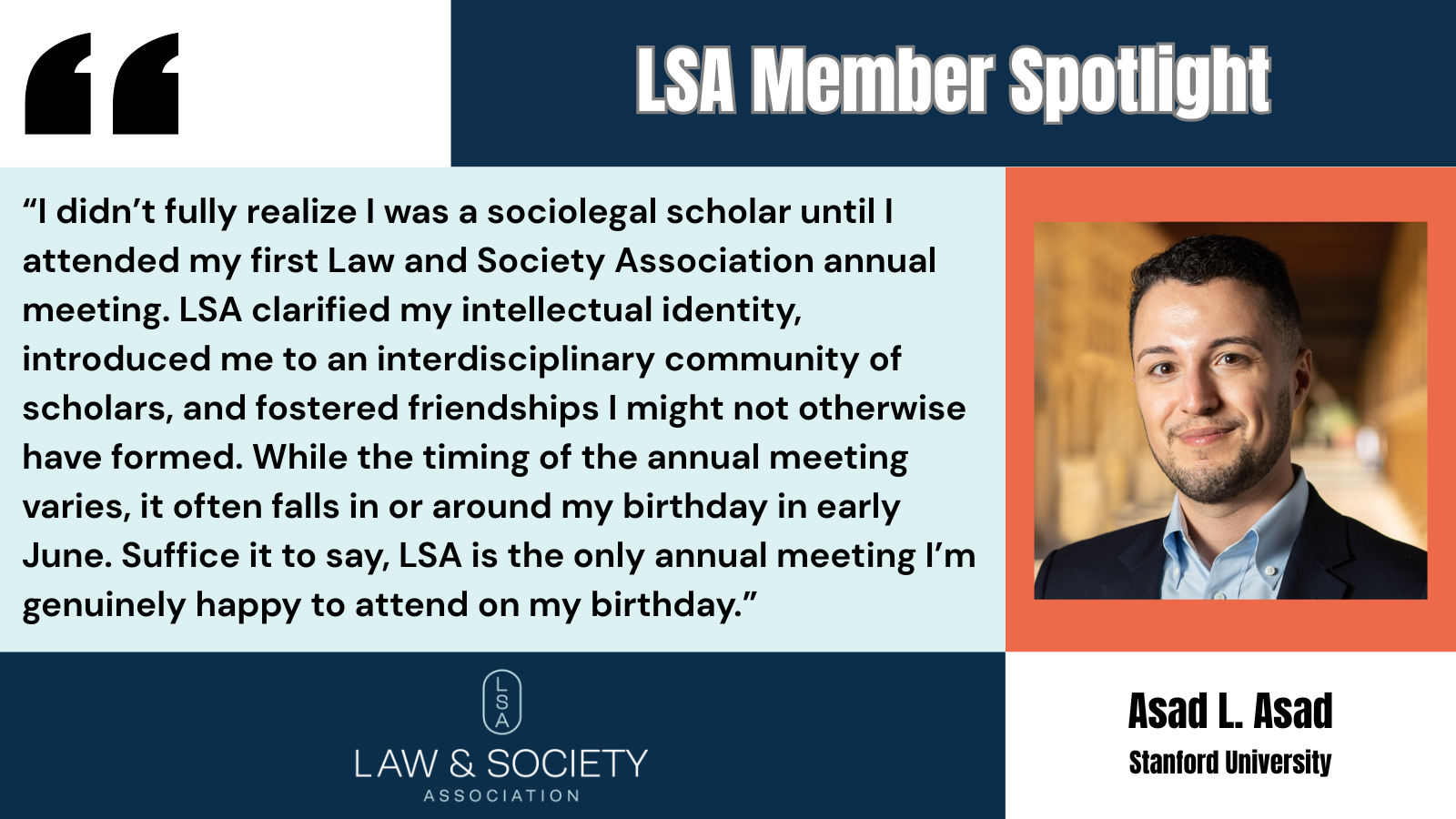
I didn’t fully realize I was a sociolegal scholar until I attended my first Law and Society Association annual meeting. LSA clarified my intellectual identity, introduced me to an interdisciplinary community of scholars, and fostered friendships I might not otherwise have formed. While the timing of the annual meeting varies, it often falls in or around my birthday in early June. Suffice it to say, LSA is the only annual meeting I’m genuinely happy to attend on my birthday.
Why should professionals or students join LSA?
LSA allows professionals and students alike to traverse disciplinary boundaries in ways that generate bigger ideas, sharper analytical tools, and more direct public impact. Much of the world we inhabit—and study—sits at the intersection of law and society. While disciplinary tools remain important, LSA offers a rare space for sustained intellectual cross-pollination. Through its annual meetings in thoughtfully selected cities around the world, as well as ongoing opportunities for professional development and engagement with scholars across career stages, LSA creates a community where people think together across difference. As careers advance and professional demands intensify, such spaces become increasingly rare. LSA ensures that, at least once a year, you can think in community with others who approach your questions from distinct intellectual and professional perspectives—and, in doing so, collectively improve your work and perhaps even a small corner of the world.
Learn more about Asad L. Asad, his many publications, awards, and involvement with academic organizations here.