

Get to know Catherine (KT) Albiston!
Institution:
University of California, Berkeley
Faculty Director, Center for the Study of Law and Society
Number of years as LSA member:
31
Number of LSA Meetings Attended:
27
LSA Governance Position(s) and Committees:
Member, Board of Trustees | 2005 – 2007
Member, Article Prize Committee | 2004 – 2005
Member, Kalven Prize Committee | 2008 – 2009
Member, Wheeler Prize Committee | 2008 – 2009
Member, Student Paper Prize Committee | 2002-2003
Chair, Student Paper Prize Committee | 2005 – 2006
Member, Nominations Committee | 2010 – 2011
Member, Law & Society Review Editorial Advisory Board
Other Association Affiliations:
American Sociological Association
American Association of Law Schools
American Bar Foundation
Work and Family Researchers Network
California Bar Association
Areas of Research:
Law and Social Change
Inequality in Employment
Access to Justice
Public Interest Law, Democracy, and Civil Society
Legal Profession
Gender and Feminist Theory
Favorite Topics to Teach or Research:
Law and Social Change
Social Movements and Law
Employment Discrimination
Gender, Law, and Society
Unique Skill or Fact:
Many years ago, I looked to see who Google thought I was based on my search history. At work, Google thought I was a man interested in law and statistics. At home, Google thought I was a woman interested in travel and shopping. No idea who Google thinks I am now…
Additional Hobbies:
Hiking
Camping
Reading fiction
Crochet
Gardening
Hanging out with my dog(s) and family
Notable Awards and Grants:
Carol D. Soc Distinguished Graduate Student Mentoring Award for Senior Faculty | 2016
Fellow, Center for Advanced Study in the Behavioral Sciences, Stanford University | 2012 – 2013
Law and Society Association Article Prize | 2012
Law and Society Association Dissertation Prize | 2002
Skadden Fellow | 1995 – 1997
Top Three Books and/or Publications:
Institutional Inequality and the Mobilization of the Family and Medical Leave Act: Rights on Leave (Cambridge University Press, 2010).
“Law’s Normative Influence on Gender Schemas: An Experimental Study on Counteracting Workplace Bias Against Mothers and Caregivers,” (Law & Social Inquiry, 2024).
“Bargaining in the Shadow of Social Institutions: Competing Discourses and Social Change in Workplace Mobilization of Civil Rights,” (Law & Society Review, 2005).
Education:
Ph.D. University of California, Berkeley | Jurisprudence and Social Policy
J.D. University of California, Berkeley
M.A. Stanford University | Sociology
B.A. Stanford University | Psychology
Major Appearances:
Law, Norms, and the Motherhood/Caretaker Bias, AALS Workshop on Women Rethinking Equality, Washington, D.C., June 21, 2011.
Democracy, Civil Society, and Public Interest Law, Paul M. Van Arsdell, Jr. Memorial Lecture on Litigation and the Legal Profession, University of Illinois School of Law, February 7, 2020.
Can Law Mitigate the Motherhood/Caretaker Bias? Weatherhead Center, Harvard University, May 3, 2019.
The Dispute Tree and the Legal Forest, Yale Law School, New Haven, CT, November 17, 2016
Cultural Meanings of Gender and Inequality, Presidential Panel, Annual Meeting of the American Sociological Association, New York, NY, August 10, 2013.
Rights on Leave: The Family and Medical Leave Act in the Courts and in the Workplace, Keynote Address, Sixth Annual Midwest Family Law Consortium Workshop, University of Wisconsin, Madison, April 5, 2013.
Rights on Leave, Clayman Institute, Stanford University, Stanford, CA, October 25, 2012.
What do you find the most beneficial about being an LSA member?
The people! LSA members love to talk across disciplinary boundaries, generally are warm and engaging people, and know how to have a good time. I have made so many friends over the years and look forward to the annual meetings to catch up with everyone.
Why should professionals or students join LSA?
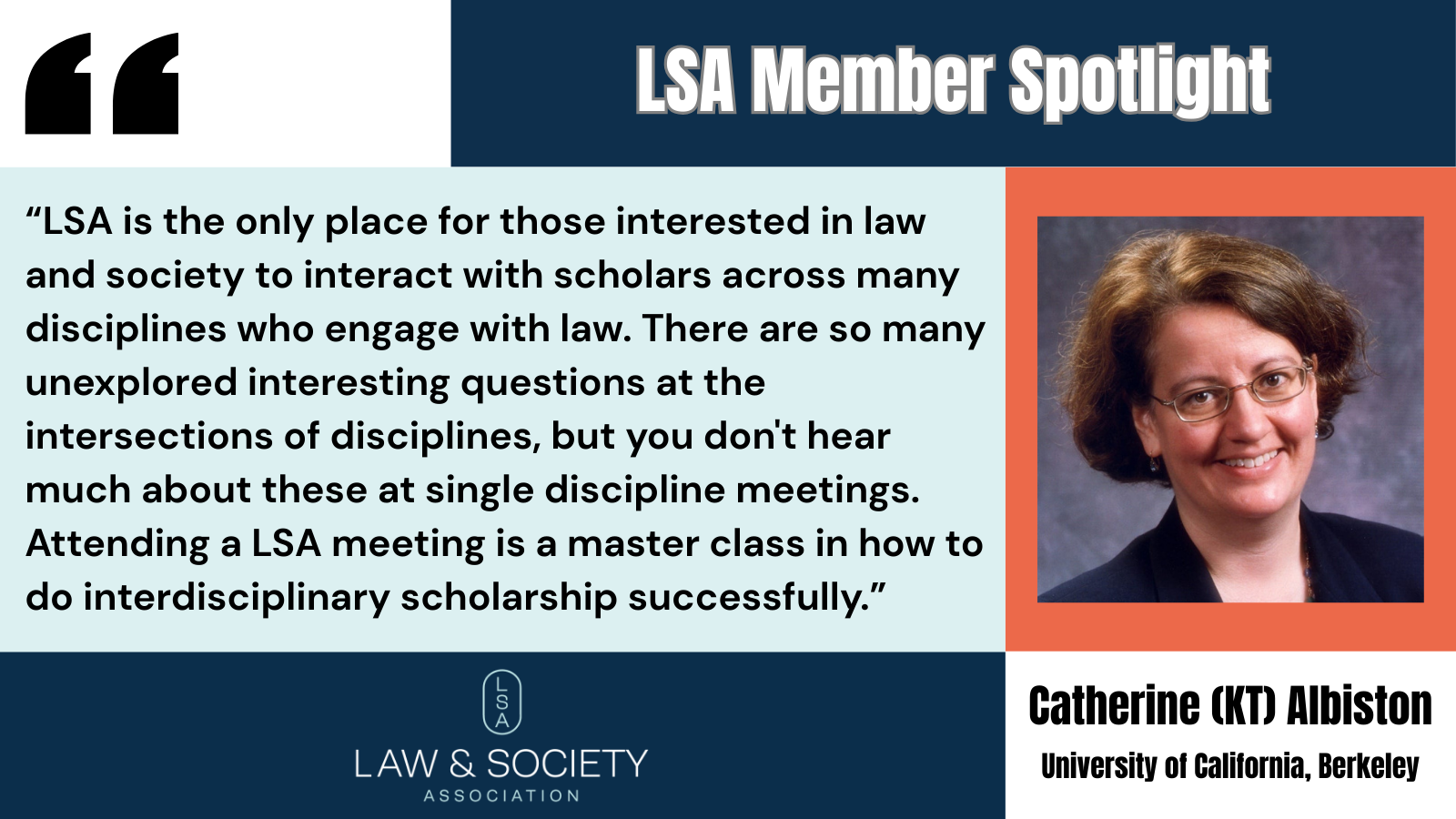
Academic careers are all about serendipity. Meeting someone with common interests, going to a thought-provoking panel, discovering a new area of inquiry – all can lead to ideas, dissertations, publications, jobs, research grants, etc. LSA is the only place for those interested in law and society to interact with scholars across many disciplines who engage with law. There are so many unexplored interesting questions at the intersections of disciplines, but you don’t hear much about these at single discipline meetings. Attending a LSA meeting is a master class in how to do interdisciplinary scholarship successfully. And LSA provides so many opportunities for professional development for students and faculty, all in a friendly, inclusive environment.
Learn more about KT Albiston, her many publications, media appearances, awards, and involvement with academic organizations here.