


Get to know LSA Board Trustee Mary Rose!
Institution:
The University of Texas at Austin
Number of years as LSA member:
32
Number of LSA Meetings Attended:
About 28
LSA Governance Position(s) and Committees:
Board of Trustees, Class of 2028 (previously Class of 2013 and Class of 2006)
Co-Chair, CRN 4: Lay Participation in Legal Systems
Member, Dissertation Prize Committee | 2019
Co-Chair, Professional Development Committee | 2015 – 2017
Member, Ad Hoc Committees on CRNs | 2014, 2010
Member, Program Committee | 2014, 2008, 2005
Co-Organizer, Early Career and Graduate Student Workshop | 2012
Member, Nominations Committee | 2007
Other Association Affiliations:
American Sociological Association
American Psychological Association
Areas of Research:
Juries and Jury Decision Making
Perceptions of Courts and Law
Psychology of Justice
Favorite Topics to Teach or Research:
Use of social science in court/legal system practice
Unique Skill or Fact:
I tend to see myself as part of whatever is “old-school” and fading away: I still go to church (Episcopal) even though mainline religion is disappearing; I study juries even as trials are vanishing; I remain committed to my political party (you can probably guess which one) even as the category of “independent” grows bigger every year. I have not given up on old-guard institutions.
Additional Hobbies:
I like to spend my time having coffee (or a meal) with friends.
Notable Awards and Grants:
Affiliated Scholar Appointment, American Bar Foundation | 2023 – Present
Academic Fellow Appointment, Roscoe Pound Institute | 2021
Outstanding Teacher of the Year, Human Dimensions of Organizations, The University of Texas at Austin | 2022
“Top Ten Professor,” Alcalde, a UT Alumni magazine | 2015
Top Books and/or Publications:
“The Focal Concerns of Jurors’ Evaluating Mitigation: Evidence from Federal Capital Verdict Forms,” Law & Society Review 56(2): 213 – 236 (2022) (with Meredith Martin Rountree).
“Jury Pool Underrepresentation in the Modern Era: Evidence from Federal Courts.” Journal of Empirical Legal Studies 15: 378 – 405. (2018) (with Raul S. Casarez and Carmen Gutierrez).
Referenced in an episode of “Last Week Tonight” on juries and race (August 16, 2020).
“Judging Bias: Juror Confidence and Judicial Rulings on Challenges for Cause.” Law and Society Review 42: 513 – 549 (2008) (with Shari Seidman Diamond).
Education:
Ph.D., Duke University | Social Psychology
M.A., Duke University | Social Psychology
A.B., Stanford University | Psychology
Major Appearances:
My work has been cited in three U.S. Supreme Court opinions:
Ramos v. Louisiana, 2020
Exxon Shipping Co. v. Baker, 2008
Miller-el v. Dretke, 2005
What do you find the most beneficial about being an LSA member?
First, LSA has been a welcoming home for my “law and” interests since I was a first-year graduate student. So, it is simply part of my core social identity as an academic. Every year, it seems I meet a new, wonderful person at an LSA meeting, the kind of person I want to listen to and learn from because they are so smart; but also, they are the kind of people you want to be friends with. LSA members are my “people.”
Second, since LSA initiated Collaborative Research Networks, CRN 04 (Lay Participation in Legal Decision Making) has been a key part of my work, my thinking, and my ability to connect regularly with other, interdisciplinary scholars of the jury.
Why should professionals or students join LSA?
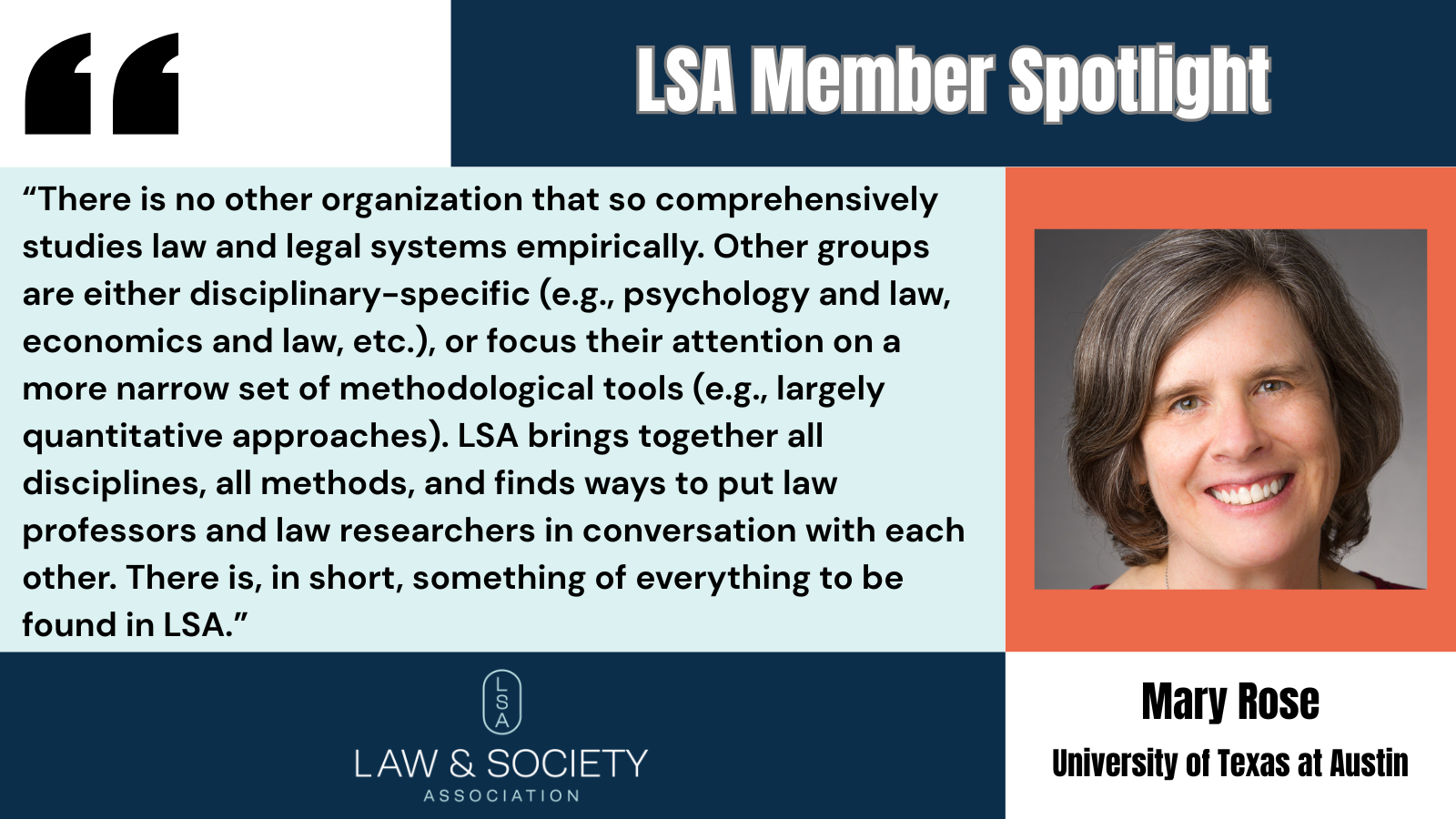
There is no other organization that so comprehensively studies law and legal systems empirically. Other groups are either disciplinary-specific (e.g., psychology and law, economics and law, etc.), or focus their attention on a more narrow set of methodological tools (e.g., largely quantitative approaches). LSA brings together all disciplines, all methods, and finds ways to put law professors and law researchers in conversation with each other. There is, in short, something of everything to be found in LSA.
For students in particular, LSA is a fantastic way to learn how to present research. It has a fairly low bar to entry in terms of getting onto the program, and students in my department have told me how kind people are to them at meetings. There are also mentoring and workshop opportunities students can and should take advantage of.
Learn more about Mary Rose, her many publications, awards, and involvement with academic organizations here.