


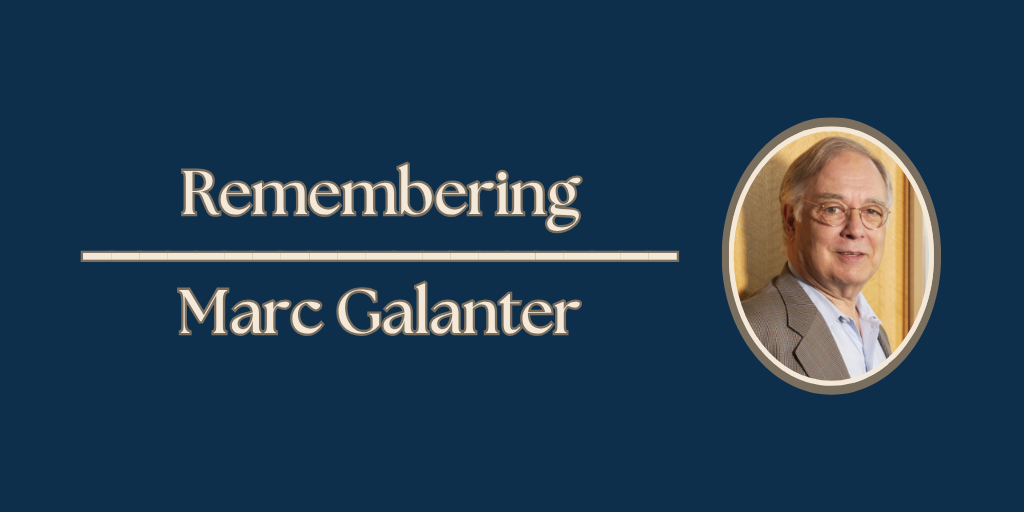
Marc Galanter
1931-2026
Richard Abel
UCLA School of Law
Marc Galanter, who died on April 14, was the Law and Society Association from its very beginning. But his story starts before its launch. Inspired in high school by Mortimer Adler’s How to Read a Book, he applied early to the University of Chicago (where Adler, a philosopher, was the first non-lawyer to teach in a law school). Placing out of two years of college by passing entrance exams in six of the 14 required courses, Marc graduated at 19 and started graduate school in philosophy. But after completing his M.A., he felt that philosophy was too abstract and followed the example of his good friend Saul Mendlovitz by going to law school, first at Penn and then for his last two years at Chicago, where he edited the law review’s book review section. Hans Zeisel was conducting his pathbreaking jury study, Soia Mentschikoff was studying on arbitration, and Marc became a mentee of Max Rheinstein. Graduating in 1956 (and expecting to be drafted), Marc stayed at Chicago on a Bigelow Teaching Fellowship, co-teaching a seminar on the legal profession with Alan Barton, a sociologist on the jury project, who later directed Columbia University’s Center for Applied Social Research. Stewart Macaulay, another Bigelow fellow (and LSA founder and stalwart), connected Marc to a program on South Asia at Stanford Law School, which offered him a two-year fellowship. He won a Fulbright fellowship and, inspired by the Supreme Court’s recent decision in Brown v. Board of Education, spent a year studying India’s abolition of untouchability, finding that its efforts to deal with the “Scheduled Castes” (analyzed in his definitive 1984 book “Competing Equalities: Law and the Backward Classes in India”) prefigured affirmative action in the U.S.
At loose ends after another year at Stanford, he accepted the offer of a one-year position teaching Sociology 3 at the University of Chicago, which led to a three-year contract, renewed for another three, and then tenure (a trajectory anticipated by David Riesman, another lawyer turned sociologist without any formal training). Marc’s scholarly home was the burgeoning South Asia program; he had no contact with the law school except his former mentor Max Rheinstein. In 1967, Marc re-encountered Lawrence Friedman at a conference at the East-West Center in Honolulu. (Lawrence had graduated from Chicago before Marc matriculated, but had known Lawrence’s wife Leah there.) Marc accepted an invitation to observe the course Lawrence and Stewart Macaulay had pioneered at Wisconsin (later embodied in their 1969 book “Law and the Behavioral Sciences”). Excited to find “somebody looking at [American] law in a way that felt like what I was doing in India, an outsider perspective on law,” he devoured the rapidly expanding interdisciplinary literature and constructed a year-long law-and-society course with two colleagues: June Tapp (psychology) and Mark Haller (history). Bernard “Barney” Cohn (an Indianist historian and anthropologist writing about law) introduced Marc to Richard “Red” Schwartz (a sociologist) and Paul Bohannan (an anthropologist), both at Northwestern University. The four met for lunch four times a year, leading Red, then Law & Society Review editor, to ask Marc to edit the papers from a conference he had organized on the Indian legal profession for a special double issue.
Before the Law and Society Association held its inaugural 1975 meeting at Buffalo Law School, it organized sessions at the annual conferences of the APSA and ASA in Chicago; the 20-member LSA board (almost the entire field at the time) also met in Chicago; Marc attended all those meetings. Lawrence introduced him to David Trubek, with whom Marc served on the board of the new International Legal Center. In the fall of 1970, Dave brought Marc to Yale Law School as a senior scholar in the Law and Modernization Program, recently given a five-year grant by USAID. Their collaboration led to an influential article: “Scholars in Self-Estrangement: Some Reflections on the Crisis in Law and Development Studies in the United States.” Although an earlier cohort of social scientists who taught as adjuncts—Schwartz, Jerome Skolnick and Philip Selznick—had left, Yale had hired Stanton Wheeler (the first social scientist tenured by any law school), who directed the Russell Sage Program (which included Donald Black, Austin Sarat, Malcolm Feeley, Jack Katz, Jerrold Guben, and Robert Kagan, among others). Robert Stevens—a Yale law professor who had written seminal books on English lawyers and taught in East Africa—led a seminar on the legal profession in which Marc participated. And this is when I met Marc, forming a friendship memorialized by a photo he took of me with our two oldest children at the circus in New Haven and has lasted the rest of his life. Yale is also where Marc completed the first draft of “How the ‘Haves’ Come Out Ahead.” After reading it, I wrote Marc that Americans now had our own Max Weber (having just encountered “Economy and Society”).
After a year back in Chicago, Marc accepted an offer of a visiting professorship at Buffalo Law School (where Red had become the first non-lawyer dean in the country) and the offer of tenure that followed. When he sent out the revised “Haves” manuscript, it was rejected by the Law & Society Review, the American Political Science Review, and at least a half dozen major law journals. A Yale Law Journal student editor wrote Marc that the article was “fascinating and well-written” but mistaken because courts could advance the claims of “have-nots.” When Marc became the LSR editor, Red suggested he announce a special issue and appoint an editor. Marc chose Robert Kidder (an anthropologist working on India) and Bliss Cartwright (a quantitative methodologist at Buffalo), who jumped at the chance—and it became the thirteenth “most-cited law review article of all time” (according to a 1996 article). Marc started teaching contracts, mentored by his new Buffalo colleague Stewart Macaulay. Marc taught in the NSF Law and Social Science Workshop in Madison in the summers of 1968 and 1969, getting to know other Wisconsin faculty members: Joel Grossman and Stuart Scheingold (political science) and Jack Ladinsky (sociology). Stewart (who had returned to Wisconsin) and Dave Trubek (who had gone there from Yale) convinced the university to invite Marc to visit, after which he accepted a tenured position, attracted by the law and social science faculty and the major South Asian studies center. The rest is history—or bibliography.
Looking back on his Fulbright year in India, Marc reflected: “Immersion in another culture is a celebrated method for exposing our presuppositions and showing us that familiar arrangements are problematic rather than the way things have to be.” I wrote something similar at the beginning of my career:
The increased understanding to be gained by such intellectual exploration seems to me similar in origin to the pleasure any of us takes in travel. Differences of physical environment, modes of social intercourse, or patterns of culture awaken us to phenomena which at home are so familiar to as to be almost invisible. When we resume our mundane round, the residue of such impressions compels us to recognize the contingency of our own ways, and leads us to look for explanations.
(Marc published that article, “A Comparative Theory of Dispute Institutions in Society” in LSR. It was the longest ever until he nominated me as his successor and I published Boaventura de Sousa Santos’s “The Law of the Oppressed: The Construction and Reproduction of Legality in Pasargada.”) I am struck by how many of our generation turned to social science to understand law after living and working in a foreign environment: David Trubek (Brazil), Stewart Macaulay (Chile), Richard Schwartz (Israel and India), William Felstiner (Turkey and India), Robert Kidder and Robert Hayden (both India), Boaventura de Sousa Santos (Brazil), myself (Kenya), Laura Nader (Mexico), and her students in the Berkeley Village Law Project: Michael Lowy (Ghana), June Starr (Turkey), Barbara Yngvesson (Sweden), Klaus-Friedrich Koch (Egypt), and Harry Todd (Germany). Marc felt that two of his major papers—“Haves” and “Justice in Many Rooms—could be seen as transpositions to the U.S. of insights he had attained in India. Similarly, both Marc’s “The Modernization of Law” and “The Displacement of Traditional Law in Modern India” constructed ideal types of tradition and modernity based on the encounter between East and West. Marc’s accounts of the Bhopal litigation implicitly contrast it with litigation in the U.S.
Although Marc focused on ascriptive categories in India, it was only in 1999 that he published an article about Jews in the American legal profession. (He had been raised in a Yiddishkeit household.) It took Rajeev Dhavan, who edited Marc’s India articles for book publication, to note how much his “focus on pluralism and accommodation reflect a (then) barely articulated concern about Jewish identity and continuity.” In 2001 Marc collaborated with Jayanth Krishnan on a comparison of the ways in which Israel and India dealt with religious personal law.
Civil litigation has been one of Marc’s constant foci. The “Haves” article has been reprinted in numerous collections, translated into Spanish, Dutch, Italian, and Portuguese, and was the subject of a symposium on its 25thanniversary. He devoted several articles to puncturing the myth propagated by the insurance industry and deep-pocket tort defendants that Americans are excessively litigious. One of those articles, “Reading the Landscape of Disputes,” was the 65th most cited law review article in 1996. Marc’s interest in litigation naturally led him to study its variants and alternatives. The massive differences between the mythic version of American law he absorbed in law school and the actual functioning of law he observed in India led him to argue, in “Justice in Many Rooms,” that legal pluralism, not monism, was the norm. This seminal article also was reprinted and translated into multiple languages. Looking through eyes opened by India, Marc perceived not only that the United States contained an enormous diversity of dispute institutions and processes but also that even its formal legal system necessarily operated in informal ways.
Marc’s interest in litigation was naturally complemented by an interest in lawyers, which dated from 1956. When the popular press began investigating the profession, especially its upper reaches, Marc wrote a 1983 article about “mega-lawyering,” which led to his collaborations with Thomas Palay on law firm growth in the U.S. and with Simon Roberts about the parallel, but different, phenomenon in the U.K. Marc extended those ideas in his work on the aging of the profession, gender differences, and the growing numbers of lawyers around the world. Just as he had debunked claims about contemporary litigiousness, so he disabused nostalgic visions of a golden age of the American legal profession.
Marc liked entertaining his numerous appreciative audiences with jokes. Irreverence, incongruity, and the counterintuitive have always been his modus operandi. He started collecting lawyer jokes unsystematically, visiting used books stores in each of the (many) cities he visited during his peripatetic lecturing, eventually amassing over a thousand volumes. Then, at a dinner hosted by Jerome Carlin in Berkeley, he met Alan Dundes, America’s leading scholar on humor. As their close friendship developed, Alan guided Marc through the world of jokes, resulting in Marc’s book “Lowering the Bar: Lawyer Jokes and Legal Culture.”
This small selection from Marc’s six books and over a hundred articles displays multiple connections despite the diversity of topics and sites: India is related to the United States, religion to caste, litigation to judging and alternative dispute settlement, and lawyers to jokes. Marc is a hoarder, never throwing anything out—not a clipping, not an article, and certainly not an idea. They get filed in libraries spreading over three floors of his Wisconsin home (to which he gave me a tour recently), where he recombines them to produce new dishes with exotic flavors and, as always, a great presentation. He constantly debunks received wisdom.
Just as Marc insists on pluralism rather than monism, he shows that every social institution and process has perverse, often unanticipated, consequences. The pursuit of equality creates its own inequalities (a vulnerability Trump and MAGA continue to exploit). Formal law cannot function without informal processes. The tournament of lawyers contains the seeds of its own destruction (attested to by recent law firm collapses). Marc internalized E.M. Forster’s exhortation: “only connect.” And in doing so, he has connected with us and all of us with each other.
***
In 2011, the Center for the Study of Law and Society at UC Berkeley Law conducted an interview with Marc as part of the Conversations in Law and Society Series. The interview, along with other conversations with foundational figures in the field, is available here:
A Conversation with Marc Galanter
***
We have created a space where members of our community can share their own memories and reflections of Marc. You can visit the in memoriam page here: